tldr:
- Know your level: Our adult lessons run from 1.0 (first time picking up a racquet) to 3.5+ (competitive club player) – knowing where you’re at is the first step.
- The jump from 1.0 to 2.0 takes most adult players between 8 to 24 sessions – and the biggest variable isn’t talent, it’s how much you play between sessions.
- Structure beats effort: Players who follow a clear pathway improve faster and are less likely to plateau than those who just play and hope for the best.
- Summer Smash teaches a proprietary Progression designed so that what you learn on day one scales to the high-levels of play, no “unlearning” required.

How long until tennis actually feels natural?
It’s the question every new adult player wonders. And the honest answer is: it depends on whether you’re following a development pathway, or just rallying and hoping for the best.
Most adults who feel stuck aren’t lacking effort. They’re lacking a map. At Summer Smash Tennis, that map is built into every lesson. Here’s what it looks like, level by level, and what to expect at each stage.
The Adult Pathway: What Each Level Really MeanS
Adult Beginner (1.0)
Starting out in tennis is one of the most exciting decisions you can make as an adult. The goal at this stage isn’t to play perfect tennis, it’s to build technique that will still serve you well at the 3.5 level and beyond. We introduce the fundamentals of groundstrokes through a structured teaching system, progressing toward consistent rallying in a shorter court setting, all while developing a genuine love for the game in a positive, welcoming environment.
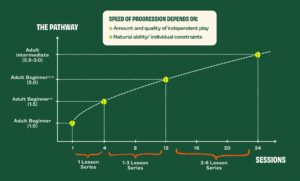
Typical time to advance: 1 lesson series (~4 sessions)
Adult Beginner (1.5)
This is where the full court starts to open up. You can rally 10 balls in a row and you’re beginning to serve from the trophy position, two milestones that feel great when they click. This stage focuses on building rally consistency, refining your groundstroke technique, and developing a technical foundation for your serve from the ground up. You’ll also get your first taste of volleying and a growing familiarity with the shot cycle.
Typical time to advance: 1–3 lesson series (4–12 sessions)
Adult Beginner++ (2.0)
This is where everything starts coming together. You are able to sustain a full-court rally with both forehand and backhand, you have a functional serve, and you’re beginning to control where the ball goes, not just whether it goes in. Ball control, movement, and shot-cycle awareness are the focus, and specific footwork patterns are introduced so you can move around the court with purpose and efficiency.
Typical time to advance: 3–6 lesson series (12–24 sessions)
Adult Intermediate (2.5-3.0)
By this point, you can (gently) rally 10 in a row from the baseline while controlling direction, and that’s a meaningful achievement. You’re still refining groundstroke technique, but movement and positioning are starting to feel more natural, and a full-motion serve is coming into focus. Improved technical ability opens the door to more nuanced tactical objectives. Through level-specific drills, games, and point-play situations, you’ll learn to handle shots from every corner of the court and the fundamentals of applying pressure through shot quality, selection, and placement. Through level-specific drills, games and point-play situations, you’ll learn to
Typical time to advance: Ongoing development
Adult Intermediate+ (3.0–3.5)
Your shot tolerance and adaptability are improving, you can handle a wider variety of balls, and your groundstrokes are consistent on standard exchanges. Topspin and slice are becoming part of your natural toolkit, volleys are usable in live point-play, and you’re starting to add spin to your serve for greater consistency. The focus here is refinement and intentionality: improving pace, depth, and spin across all shots while sharpening the tactical awareness to know not just how to hit, but when and why.
Typical time to advance: Ongoing development

The Single Biggest Factor in How Fast You Progress
It’s not how often you take lessons. It’s what you do between them.
Tennis is a motor skill. The players who break through quickly are almost always the ones hitting outside of lessons, even just rallying with a friend for 30 minutes twice a week. That repetition is where the technique your coach introduces gets locked into muscle memory.
The graph above shows what an average player pathway looks like across sessions. The curve flattens at Beginner++ (2.0), not because improvement stops, but because time spent on court consolidating becomes the limiting factor.
Why the Teaching System Matters
Not all coaching gets you to the same place. At Summer Smash, every coach teaches from the same structured curriculum, developed and refined over 15+ years in consultation with some of Canada’s most successful coaches.
What this means for you: the technique you learn at 1.0 isn’t replaced at 2.0. It’s built upon. Every level connects to the next. You never have to unlearn anything.
When you move between coaches or take a break and come back, the framework is consistent. Your progress doesn’t reset.
How to Know You’re Ready to Move Up
Your coach will tell you, but here are the honest benchmarks:
- 1.0 → 1.5: Consistent forehand from shorter court; basic repeatable technique on both sides
- 1.5 → 2.0: Can rally 10 in a row from three-quarter court; serve is in play
- 2.0 → 2.5: Full-court rally with both strokes; controlling direction and height; full-motion serve
If you’re not hitting those marks yet, that’s not a problem, it just means you’re exactly where you need to be.
Frequently Asked Questions
- How many lessons does it take to become a 2.0 tennis player? Most adults reach 2.0 in 12–24 sessions with structured coaching and regular play in between.
- Can adults improve their tennis level quickly? Yes! The three biggest factors are quality of instruction, consistency of technique across lessons, and time spent hitting between sessions.
- What’s the difference between a 2.0 and 2.5 tennis player? At 2.0, you’re sustaining rallies. At 2.5, you’re directing them – controlling depth, height, and placement during live points.
- Do I need private lessons to level up? Not necessarily. Structured group lessons are highly effective for building technique (and finding hitting partners to practice with). Private lessons add the most value once you have a foundation and want targeted work on specific areas.
The pathway is clear. The technique is proven. The only thing left is to get on court.